







The Key Question: Does a Diesel Engine Have a Spark Plug?
Many vehicle owners assume that all internal combustion engines use spark plugs to ignite fuel. This assumption comes from the fact that gasoline-powered vehicles rely heavily on spark plugs for engine operation.
However, diesel engines function differently.
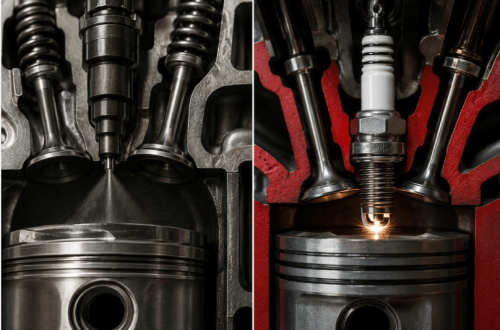
A diesel engine does not use spark plugs to ignite the fuel-air mixture. Instead, diesel engines use a process called compression ignition. In this process, air inside the cylinder becomes extremely hot due to high compression. When diesel fuel enters the hot compressed air, it ignites automatically without the need for a spark.
Because the fuel ignites from heat generated by compression, spark plugs are unnecessary in diesel engines.
This unique ignition method is one of the main reasons diesel engines are known for their durability, efficiency, and high torque output.
Understanding How Engine Ignition Works
To understand why diesel engines do not need spark plugs, it helps to understand the basic purpose of a spark plug.
A spark plug creates a small electrical spark inside the engine cylinder. This spark ignites the air-fuel mixture and starts the combustion process.
In gasoline engines, the fuel and air mix together before entering the cylinder. Since gasoline does not ignite easily under normal compression levels, an external spark is needed.
The combustion process follows these steps:
- Air and fuel enter the cylinder.
- The piston compresses the mixture.
- The spark plug generates a spark.
- The mixture ignites.
- Combustion pushes the piston downward.
Without the spark plug, a gasoline engine would not run properly.
Diesel engines follow a completely different process.
The Background: How Diesel Engines Work
Diesel engines operate using compression ignition rather than spark ignition.
The process works as follows:
Step 1: Air Enters the Cylinder
Only air enters the combustion chamber during the intake stroke.
Unlike gasoline engines, fuel is not mixed with air before compression.
Step 2: Air Is Compressed
The piston moves upward and compresses the air to a very high pressure.
Diesel engines typically have compression ratios between 14:1 and 25:1, much higher than gasoline engines.
Step 3: Temperature Increases
As the air becomes compressed, its temperature rises dramatically.
Temperatures can exceed:
- 500°C (932°F)
- Sometimes even higher under heavy loads
Step 4: Fuel Injection
Near the top of the compression stroke, diesel fuel is injected directly into the hot air.
Step 5: Automatic Ignition
The heat generated by compression causes the diesel fuel to ignite instantly.
No spark is required.
Step 6: Power Production
The expanding gases force the piston downward, creating power.
This process repeats continuously while the engine runs.
Why Diesel Engines Do Not Need Spark Plugs
Several factors eliminate the need for spark plugs in diesel engines.
1. High Compression Creates Heat
The primary reason is the extremely high compression ratio.
Compression alone generates enough heat to ignite diesel fuel.
Since ignition occurs naturally, no spark source is necessary.
2. Diesel Fuel Has Different Properties
Diesel fuel behaves differently from gasoline.
Gasoline:
- Evaporates quickly
- Requires a spark for ignition
- Burns rapidly
Diesel fuel:
- Is less volatile
- Ignites under high pressure and heat
- Burns more slowly and efficiently
These characteristics make compression ignition possible.
3. Simpler Ignition System
Because spark plugs are unnecessary, diesel engines do not require:
- Spark plug wires
- Ignition coils
- Distributor systems
- Traditional ignition modules
This reduces the number of ignition-related components.
What Do Diesel Engines Use Instead of Spark Plugs?
Many people hear about glow plugs and mistakenly think they are spark plugs.
They are not the same thing.
What Is a Glow Plug?
A glow plug is a heating device used primarily during cold starts.
Its purpose is to warm the combustion chamber when outside temperatures are low.
Unlike spark plugs, glow plugs do not create sparks.
Instead, they generate heat.
How Glow Plugs Work
When the ignition system activates:
- Electricity flows to the glow plug.
- The tip becomes extremely hot.
- The combustion chamber warms up.
- Starting becomes easier in cold weather.
Once the engine reaches operating temperature, glow plugs generally stop functioning.
The engine then relies entirely on compression ignition.
Spark Plugs vs Glow Plugs
Many new diesel owners confuse these components.
| Feature | Spark Plug | Glow Plug |
|---|---|---|
| Used In | Gasoline Engines | Diesel Engines |
| Produces Spark | Yes | No |
| Produces Heat | Limited | Yes |
| Required During Operation | Continuously | Mainly During Startup |
| Ignites Fuel Directly | Yes | No |
| Purpose | Create Ignition Spark | Assist Cold Starting |
This comparison clearly shows that glow plugs are not replacements for spark plugs.
They serve a completely different purpose.
Are There Any Diesel Engines With Spark Plugs?
Traditional diesel engines do not use spark plugs.
However, some specialized engine technologies have experimented with spark-assisted combustion systems.
Examples include:
- Experimental diesel engines
- Research engines
- Hybrid combustion systems
These are uncommon and rarely found in everyday vehicles.
For nearly all production diesel cars, trucks, and equipment, spark plugs are absent.
Advantages of Compression Ignition
The compression ignition system offers several benefits.
Better Fuel Efficiency
Diesel engines typically consume less fuel than comparable gasoline engines.
This efficiency comes from:
- Higher compression ratios
- More complete combustion
- Greater thermal efficiency
Higher Torque
Diesel engines generate strong low-end torque.
This makes them ideal for:
- Towing
- Hauling
- Commercial transportation
- Heavy machinery
Improved Durability
Diesel engines often last longer because their components are built to withstand high compression pressures.
Many diesel engines exceed hundreds of thousands of miles with proper maintenance.
Reduced Ignition Maintenance
Without spark plugs, owners avoid:
- Spark plug replacement
- Ignition wire replacement
- Ignition coil failures
This can lower long-term maintenance costs.
Common Problems Related to Diesel Ignition
Although diesel engines do not have spark plugs, they can experience ignition-related issues.
Faulty Glow Plugs
Bad glow plugs may cause:
- Hard starting
- Rough idle
- Excessive smoke
- Longer cranking times
Weak Battery
Diesel engines require strong batteries because high compression demands more starting power.
Fuel Injector Problems
Faulty injectors may affect combustion quality and engine performance.
Low Compression
Worn piston rings or valves can reduce compression.
Without sufficient compression, diesel fuel may not ignite properly.
Cold Weather Issues
Extreme cold can make diesel fuel thicker and harder to ignite.
Glow plugs help overcome this challenge.
Maintenance Tips for Diesel Engines
To keep a diesel engine running efficiently:
Inspect Glow Plugs
Check glow plugs periodically, especially before winter.
Use Quality Fuel
High-quality diesel fuel improves combustion and injector performance.
Replace Fuel Filters
Clean fuel filters help maintain proper fuel delivery.
Monitor Compression
Low compression can indicate internal engine wear.
Follow Service Intervals
Regular maintenance extends engine life and improves reliability.
How to Tell if Your Vehicle Has a Diesel Engine
If you are unsure whether your vehicle is diesel-powered, look for these signs:
- Diesel label near the fuel cap
- Higher torque ratings
- Glow plug indicator light on the dashboard
- Manufacturer specifications
- Diesel engine sound, often deeper and louder than gasoline engines
If the vehicle is diesel-powered, it almost certainly does not use spark plugs.
Conclusion
The answer to the question “Does diesel engine have a spark plug?” is straightforward: No, traditional diesel engines do not have spark plugs.
Instead of using spark ignition like gasoline engines, diesel engines rely on compression ignition. Air inside the cylinder is compressed to extremely high pressures, generating enough heat to ignite diesel fuel automatically. Because combustion occurs through heat rather than an electrical spark, spark plugs are unnecessary.
Some diesel engines use glow plugs, but these components only assist with cold starts and do not ignite fuel directly. Understanding this difference helps vehicle owners better maintain their engines and appreciate the unique advantages of diesel technology.
Whether you drive a diesel car, truck, tractor, or industrial machine, knowing how compression ignition works can help you diagnose problems, perform proper maintenance, and make informed decisions about engine care.
FAQs
1. Does a diesel engine have spark plugs?
No. Traditional diesel engines do not use spark plugs because diesel fuel ignites through compression-generated heat.
2. What do diesel engines use instead of spark plugs?
Most diesel engines use glow plugs to help with cold starts, but ignition occurs through compression rather than a spark.
3. Can a diesel engine run without glow plugs?
In warm conditions, many diesel engines can operate without glow plugs once started. However, cold-weather starting may become difficult.
4. Why doesn’t diesel fuel need a spark plug?
Diesel fuel ignites when injected into highly compressed, hot air inside the combustion chamber.
5. Are glow plugs the same as spark plugs?
No. Glow plugs generate heat for easier starting, while spark plugs create electrical sparks for fuel ignition.
6. How many glow plugs does a diesel engine have?
Most diesel engines have one glow plug per cylinder. A four-cylinder diesel engine usually has four glow plugs.
7. What happens when diesel glow plugs fail?
Failed glow plugs can cause hard starting, rough idling, white smoke, and poor cold-weather performance.