







Introduction: The Key Question
Many vehicle owners and car enthusiasts often ask, do diesel engines have spark plugs? This question usually arises when people learn that both gasoline and diesel engines use internal combustion to generate power. Since spark plugs play a crucial role in gasoline engines, many assume that diesel engines use them as well.
The short answer is no, diesel engines do not have spark plugs. Instead, they rely on a completely different ignition process known as compression ignition. However, the explanation is more detailed than that. Understanding how diesel engines start and operate can help drivers maintain their vehicles properly, diagnose engine problems, and make informed decisions when purchasing a vehicle.
This article explains why diesel engines do not use spark plugs, how diesel combustion works, the role of glow plugs, and what vehicle owners should know about diesel engine maintenance.
Understanding the Background: How Engine Ignition Works
To understand why diesel engines do not have spark plugs, it is important to first understand how combustion occurs inside an engine.
Internal combustion engines generate power by burning a mixture of fuel and air inside cylinders. The energy released during combustion pushes pistons, which ultimately drive the vehicle.
There are two primary types of internal combustion engines:
- Gasoline engines
- Diesel engines
Although both perform the same basic function, they ignite fuel differently.
How Gasoline Engines Use Spark Plugs
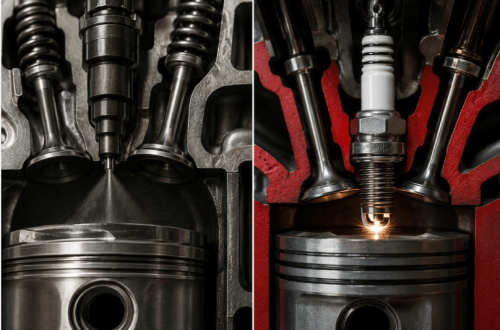
In a gasoline engine, fuel and air mix before entering the combustion chamber. When the piston compresses this mixture, a spark plug produces an electrical spark.
This spark ignites the air-fuel mixture and creates a controlled explosion. The explosion forces the piston downward and generates power.
Without spark plugs, gasoline engines cannot ignite the fuel mixture properly.
Key components include:
- Spark plugs
- Ignition coils
- Fuel injectors
- Air intake system
The spark plug serves as the critical ignition source.
How Diesel Engines Differ
Diesel engines use a completely different process.
Instead of mixing fuel and air before compression, diesel engines compress only air inside the cylinder.
As the piston moves upward, the air becomes extremely compressed. This compression significantly increases air temperature.
When diesel fuel is injected into this superheated air, the fuel ignites automatically.
No spark is required.
This process is known as compression ignition.
Because diesel fuel ignites from heat generated by compression, spark plugs are unnecessary.
Why Diesel Engines Do Not Need Spark Plugs
The main reason diesel engines do not need spark plugs is that diesel fuel has different combustion characteristics than gasoline.
High Compression Ratios
Diesel engines operate with much higher compression ratios.
Typical gasoline engine compression ratios:
- 8:1 to 12:1
Typical diesel engine compression ratios:
- 14:1 to 25:1
The higher compression creates enough heat to ignite diesel fuel naturally.
Self-Ignition of Diesel Fuel
Diesel fuel is designed to ignite under pressure and heat.
When fuel enters the combustion chamber, temperatures may exceed:
- 500°C (932°F)
At these temperatures, diesel fuel ignites immediately.
Because ignition occurs naturally, spark plugs become unnecessary.
Simpler Ignition System
Diesel engines eliminate many ignition components found in gasoline vehicles.
They generally do not require:
- Spark plugs
- Ignition coils
- Distributor systems
- Spark plug wires
This design contributes to the durability and reliability for which diesel engines are known.
What Are Glow Plugs?
One reason people become confused about spark plugs in diesel engines is the presence of glow plugs.
Glow plugs are not spark plugs.
They perform a completely different function.
Purpose of Glow Plugs
Diesel engines can experience difficulty starting in cold weather.
When temperatures drop significantly, compressed air may not become hot enough for reliable ignition.
Glow plugs help solve this problem.
They are small heating devices installed in each cylinder.
Before the engine starts, glow plugs heat the combustion chamber.
This additional heat makes fuel ignition easier during cold starts.
How Glow Plugs Work
When the driver turns the key or presses the start button:
- Glow plugs receive electrical power.
- Their tips become extremely hot.
- Heat warms the combustion chamber.
- Diesel fuel ignites more easily.
After the engine reaches operating temperature, glow plugs usually turn off.
Unlike spark plugs, glow plugs do not create sparks.
They only provide heat.
Signs of Failing Glow Plugs
Common symptoms include:
- Hard starting in cold weather
- Rough idle after startup
- Increased exhaust smoke
- Engine misfires during startup
- Illuminated dashboard warning lights
Replacing faulty glow plugs can restore proper cold-weather performance.
Common Myths About Diesel Engines and Spark Plugs
Myth 1: Diesel Engines Use Larger Spark Plugs
This is false.
Diesel engines do not use spark plugs at all.
Instead, they rely on compression ignition.
Myth 2: Glow Plugs Are the Same as Spark Plugs
Glow plugs and spark plugs perform different tasks.
Spark plugs create ignition sparks.
Glow plugs generate heat.
Their designs, functions, and operating methods are completely different.
Myth 3: Diesel Engines Cannot Start Without Glow Plugs
This is only partially true.
In warm climates, many diesel engines can start without glow plugs.
However, cold-weather starting becomes difficult without them.
Myth 4: Modern Diesel Engines Have Spark Plugs
Even modern diesel engines continue to use compression ignition.
Advanced fuel injection technology improves efficiency, but spark plugs remain unnecessary.
Advantages of Diesel Engine Ignition Systems
Because diesel engines do not require spark plugs, they offer several advantages.
Reduced Maintenance
Gasoline engines require periodic spark plug replacement.
Diesel engines eliminate this maintenance task.
Vehicle owners save time and money over the life of the engine.
Greater Durability
Fewer ignition components mean fewer parts can fail.
This contributes to the long lifespan commonly associated with diesel engines.
Better Fuel Efficiency
Compression ignition extracts more energy from fuel.
As a result, diesel engines often achieve better fuel economy than comparable gasoline engines.
Higher Torque Output
Diesel engines generate substantial low-end torque.
This makes them ideal for:
- Trucks
- Towing
- Commercial vehicles
- Heavy-duty applications
Diesel Engine Maintenance Tips
Although diesel engines do not have spark plugs, proper maintenance remains essential.
Replace Fuel Filters Regularly
Diesel injection systems are highly precise.
Dirty fuel can damage injectors and reduce performance.
Monitor Glow Plug Condition
Faulty glow plugs can create starting problems.
Have them inspected if cold starts become difficult.
Use Quality Diesel Fuel
High-quality fuel helps prevent injector deposits and combustion issues.
Follow Oil Change Intervals
Diesel engines place significant demands on engine oil.
Regular oil changes protect internal components.
Check Air Filters
Proper airflow supports efficient combustion and fuel economy.
Replace clogged air filters according to manufacturer recommendations.
Inspect Fuel Injectors
Fuel injectors play a critical role in diesel combustion.
Poor injector performance can lead to:
- Reduced power
- Increased smoke
- Lower fuel efficiency
Should You Buy a Diesel Vehicle?
Understanding diesel ignition systems can help buyers decide whether a diesel vehicle meets their needs.
Diesel vehicles are often ideal for:
- Long-distance driving
- Frequent towing
- Commercial use
- Heavy loads
- High annual mileage
Gasoline vehicles may be better for:
- Short city trips
- Lower annual mileage
- Lower initial purchase costs
Modern diesel engines deliver excellent efficiency and durability, making them popular among truck owners and long-distance drivers.
Conclusion
So, do diesel engines have spark plugs? The answer is no. Diesel engines operate using compression ignition rather than spark ignition. Instead of relying on electrical sparks, diesel engines compress air to extremely high temperatures and then inject fuel, causing automatic combustion.
While diesel engines do not use spark plugs, many utilize glow plugs to assist with cold-weather starting. Glow plugs generate heat, not sparks, and should not be confused with spark plugs.
Understanding this difference helps vehicle owners better maintain their engines, diagnose problems, and appreciate the engineering behind diesel technology. Whether you own a diesel truck, SUV, or commercial vehicle, knowing how the ignition system works can lead to better maintenance decisions and improved vehicle performance over time.
FAQs
1. Do diesel engines have spark plugs?
No. Diesel engines use compression ignition and do not require spark plugs to ignite fuel.
2. What do diesel engines use instead of spark plugs?
Diesel engines rely on high compression to generate heat for ignition. Many also use glow plugs to assist during cold starts.
3. Are glow plugs the same as spark plugs?
No. Glow plugs produce heat, while spark plugs generate an electrical spark to ignite fuel.
4. Why don’t diesel engines need spark plugs?
Diesel fuel ignites automatically when injected into highly compressed, hot air inside the combustion chamber.
5. Can a diesel engine run without glow plugs?
In warm conditions, many diesel engines can start without glow plugs. However, cold-weather starting may become difficult.
6. How long do diesel glow plugs last?
Most glow plugs last between 60,000 and 100,000 miles, although lifespan varies by vehicle and operating conditions.
7. What happens when diesel glow plugs fail?
Failed glow plugs can cause hard starting, rough idling, increased exhaust smoke, and poor cold-weather performance.