
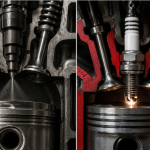








Do diesel engines have spark plugs? It is one of the most common questions asked by automotive enthusiasts and everyday drivers alike.
The short answer is no, diesel engines do not have spark plugs. While gasoline-powered vehicles rely on an electrical spark to ignite their fuel, diesel engines operate on an entirely different thermodynamic principle: compression ignition. Understanding why diesel engines lack spark plugs requires a deep dive into the engineering, physics, and historical development of internal combustion engines.
Below, we break down exactly how diesel engines work, how they differ from gasoline engines, and how they use alternative components like glow plugs to get the job done.
1. How Internal Combustion Engines Work: The Basics
To understand why a diesel engine doesn’t need a spark plug, we must first look at the basic requirements of any internal combustion engine. Whether an engine runs on gasoline, diesel, natural gas, or biofuels, it requires three core elements to generate power:
Air (Oxygen)
Fuel (Chemical Energy)
Heat (Ignition Source)
These three elements form the classic “fire triangle.” The difference between a gasoline engine and a diesel engine lies entirely in how the heat is introduced to initiate the combustion process.
2. Gasoline vs. Diesel: A Tale of Two Cycles
The automotive world is largely split into two different engineering designs: the Otto Cycle (used by gasoline engines) and the Diesel Cycle (used by diesel engines).
The Gasoline Engine (The Otto Cycle)
In a traditional gasoline engine, air and fuel are mixed together before they enter the cylinder (or directly injected into the cylinder during the intake stroke).
As the piston moves upward during the compression stroke, it squeezes this air-fuel mixture. However, gasoline engines are carefully designed not to let the mixture get hot enough to ignite on its own. Premature ignition causes a destructive phenomenon known as “engine knocking” or “pinging.”
To safely ignite the fuel at the exact right millisecond, the engine utilizes an electrical system to send a high-voltage current to a spark plug. The resulting spark acts as the match that lights the fire, forcing the piston downward to create mechanical power.
The Diesel Engine (The Diesel Cycle)
Invented by Rudolf Diesel in the late 19th century, the diesel engine eliminates the spark plug entirely by utilizing extreme pressure.
In a diesel engine, only pure air is drawn into the cylinder during the intake stroke. As the piston moves upward during the compression stroke, it compresses this air to a fraction of its original volume. Because compressing a gas rapidly increases its temperature (a fundamental law of thermodynamics), the air inside a diesel cylinder becomes incredibly hot—often reaching temperatures between and ( to ).
Just as the piston reaches the top of its stroke, a high-pressure fuel injector sprays a fine mist of diesel fuel directly into this superheated air. Because the ambient temperature inside the chamber is well above the autoignition temperature of diesel fuel, the fuel instantly ignites upon contact with the air. Consequently, no external electrical spark is required to start the fire.
3. Compression Ratio: The Secret Behind Diesel Efficiency
The core reason diesel engines can achieve self-ignition is their exceptionally high compression ratio.
The compression ratio measures how much the engine squeezes the volume of air inside the cylinder.
Gasoline Engines: Typically feature a compression ratio between 8:1 and 12:1. If they compressed the air-fuel mixture any further, the gasoline would ignite prematurely, causing severe engine damage.
Diesel Engines: Operate with massive compression ratios ranging from 14:1 to as high as 25:1. Because there is no fuel present in the cylinder during the compression stroke, the engine can squeeze the air as much as physically possible without any risk of premature detonation.
This massive compression is precisely why diesel engines are significantly more fuel-efficient than their gasoline counterparts. Higher compression translates directly into greater thermodynamic efficiency, allowing diesel vehicles to extract more mechanical energy out of every drop of fuel.
4. If Diesels Don’t Have Spark Plugs, What Are Glow Plugs?
If you look under the hood of a modern diesel truck or car, you might spot an electrical component that looks remarkably similar to a spark plug. These are called glow plugs, and they are frequently confused with spark plugs by novice mechanics.
What is a Glow Plug?
While a spark plug emits a continuous electrical arc to ignite fuel throughout the entire time the engine is running, a glow plug is essentially a heating element. Think of it like a miniature toaster wire or the element on an electric stove.
Why Do Diesel Engines Need Glow Plugs?
When a diesel engine is cold, the metal engine block and cylinder walls absorb the heat generated during the compression stroke. If the ambient temperature outside is freezing, the air inside the cylinder might not reach a high enough temperature to trigger autoignition when the fuel is injected.
To solve this cold-start dilemma, engineers developed the glow plug.
When you turn the ignition key of a diesel vehicle (or press the start button), electricity is sent to the glow plugs.
The tips of the glow plugs heat up to a bright red glow within seconds.
This intense localized heat warms up the combustion chamber.
When you crank the engine, the compressed air combines with the heat of the glow plug to successfully ignite the diesel fuel.
Do Glow Plugs Run Constantly?
No. Once the engine has started and reached its optimal operating temperature, the heat generated by the continuous combustion process is more than enough to maintain self-ignition. At that point, the computer shuts off power to the glow plugs completely. Therefore, glow plugs are strictly used for starting and initial stabilization, whereas spark plugs must fire millions of times per hour for as long as a gasoline engine runs.
5. Summary Table: Spark Plugs vs. Glow Plugs
To help synthesize the technical differences between these two vital automotive components, consider the following structural and operational comparison:
6. Fuel Properties: Gasoline vs. Diesel
The absence of spark plugs in a diesel engine is also dictated by the chemical characteristics of the fuel itself. Gasoline and diesel are refined from the same crude oil, but they possess drastically different physical properties.
Volatility and Flash Point
Gasoline is a highly volatile, lightweight fuel with a low flash point. It evaporates quickly at room temperature and catches fire easily from an open flame or spark. However, its autoignition temperature—the point at which it explodes from heat alone without a spark—is relatively high.
Diesel fuel, conversely, is much thicker, heavier, and resembles light oil. It has a high flash point, meaning you could theoretically drop a lit match into a puddle of diesel fuel and the match would go out. However, diesel has a much lower autoignition temperature than gasoline. When subjected to the immense heat of a high-compression diesel cylinder, it readily combusts on its own.
7. The Advantages and Disadvantages of Compression Ignition
By abandoning the spark plug and choosing compression ignition instead, diesel engines unlock unique performance traits.
The Advantages:
Superior Torque: Because of the high compression ratios and slow-burning nature of diesel fuel, diesel engines produce massive amounts of low-end torque. This makes them ideal for heavy hauling, towing, and industrial applications.
Enhanced Fuel Economy: Diesel engines operate at a higher thermal efficiency, meaning they waste less energy as heat and convert more of it into forward motion.
Extreme Longevity: To withstand the punishing pressures of compression ignition, diesel engine blocks, pistons, and rods must be built incredibly thick and durable. Consequently, diesel engines routinely last twice as long as gasoline engines.
The Disadvantages:
Rougher Idle and Noise: The rapid, violent pressure spikes associated with compression ignition create the distinct “clatter” or rattling sound that diesel engines are famous for.
Higher Manufacturing Costs: Due to the heavy-duty materials required to survive high compression, diesel engines are more expensive to engineer and manufacture.
Cold Weather Sensitivities: If glow plugs fail, a diesel engine can become nearly impossible to start in freezing winter temperatures.
8. Final Verdict: A Spark-Free Powerhouse
In conclusion, diesel engines absolutely do not have spark plugs. They simply do not need them.
By manipulating the laws of physics and using extreme compression ratios to superheat air, Rudolf Diesel created an engine design that relies entirely on self-ignition. While they utilize glow plugs to overcome cold weather starting hurdles, the mechanical heartbeat of a diesel engine relies solely on pressure, heat, and precise fuel injection.
Understanding this fundamental difference helps demystify how these heavy-duty workhorses power our global transportation, shipping, and industrial networks without ever needing a single electrical spark to keep moving.