







Learning how to drive a manual car can feel difficult when you are used to an automatic. Instead of simply selecting Drive and pressing the gas, you have to coordinate a clutch pedal, gear shifter, accelerator, and brake. The first few attempts may include jerky starts or a stalled engine. That is normal. The key is learning one skill at a time rather than trying to master everything at once.
A manual transmission gives you direct control over which gear the vehicle uses. Your left foot operates the clutch, while your right foot controls the brake and accelerator. Your right hand operates the gear shifter. The most important skill is learning where the clutch begins to engage. This is commonly called the friction point or bite point. Once you understand that point, starting from a stop becomes much easier.
For a beginner, the best place to practice is a flat, open area with little or no traffic. Start by learning the pedals and gear pattern with the vehicle stationary. Then practice moving the car a few feet at a time. Once you can pull away smoothly, work on shifting into second and third gear.
This guide explains the entire process in simple steps. You will learn how to start a manual car, move away from a stop, shift gears, downshift, stop, handle hills, avoid common mistakes, and build confidence behind the wheel.
What You Need to Know Before Driving a Manual Car
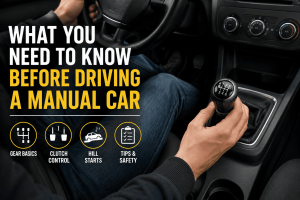
Before starting the engine, become familiar with the controls. A typical manual car has three pedals. From left to right, they are the clutch, brake, and accelerator. The clutch is operated with your left foot. The brake and accelerator are operated with your right foot.
The gear shifter normally has a pattern showing where each gear is located. Many vehicles use five or six forward gears, plus reverse and neutral. However, the exact pattern varies between vehicles, so always look at the shift knob or owner’s manual before practicing.
Clutch
The clutch temporarily disconnects the engine from the transmission. You press it when starting, stopping, or changing gears.
Brake
The brake slows or stops the vehicle. Use your right foot because the same foot also controls the accelerator.
Accelerator
The accelerator controls engine power. In a manual car, you need to coordinate it with clutch movement when starting from a stop.
Neutral
Neutral means the transmission is not engaged with a forward or reverse gear. The shifter usually moves freely from side to side when it is in neutral.
Parking Brake
The parking brake keeps the vehicle from moving while parked. It is also useful when learning hill starts.
How the Clutch Works
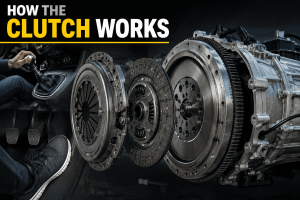
The clutch is the part that makes manual driving feel unfamiliar. When you press the clutch pedal fully, the engine is temporarily separated from the transmission. This allows you to select another gear.
As you slowly release the clutch, it begins transferring power to the transmission. The point where you first feel the vehicle respond is commonly called the friction point or bite point.
Learning this point should be your first major practice exercise. Smart Drive Test specifically emphasizes clutch control as the fundamental skill for beginners.
With the engine running and the parking brake applied, press the clutch fully. Select first gear. Slowly release the clutch until you feel a slight change in engine sound or movement from the vehicle. Then press the clutch back down.
Repeat this several times.
You are not trying to drive yet. You are training your left foot to recognize where the clutch starts engaging.
How to Start a Manual Car
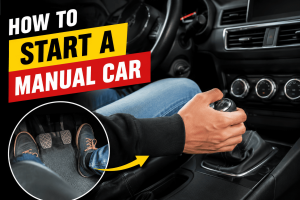
Starting the car is simple once you know the correct sequence.
- Sit comfortably and adjust the seat.
- Make sure the parking brake is engaged.
- Confirm the shifter is in neutral.
- Press the clutch fully with your left foot.
- Press the brake with your right foot.
- Start the engine.
- Keep the clutch depressed.
- Select first gear.
- Release the parking brake when you are ready to move.
The exact starting procedure can vary between vehicles. Some modern vehicles have additional clutch-start safety systems, so follow the vehicle’s owner’s manual when necessary.
Before practicing, make sure you are in a safe location with enough space to stop. A flat, low-traffic area is much easier for a beginner than a busy road.
How to Move a Manual Car From a Stop
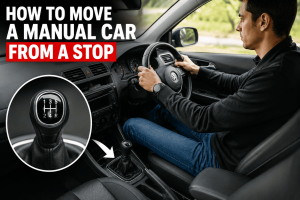
This is usually the hardest part for a new driver.
With first gear selected, slowly release the clutch. Do not immediately release it completely. Instead, move your foot gradually until you feel the car begin to pull forward.
This is the bite point.
Once you feel the car start moving, gently add a small amount of accelerator. Continue releasing the clutch smoothly as the vehicle gains momentum.
The important thing is coordination. You do not want to suddenly release the clutch or press the accelerator aggressively.
Think of the process as a smooth transition:
Clutch down → first gear → slowly release clutch → reach bite point → gently add gas → release clutch fully.
If the engine stalls, do not panic. Press the clutch and brake, return the shifter to neutral, restart the engine, and try again.
Stalling is a normal part of learning. Your goal is to understand why it happened and adjust your clutch or accelerator control on the next attempt.
How to Shift Gears
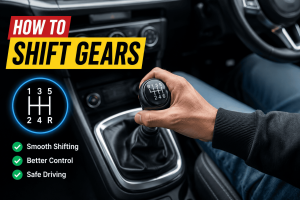
Once the vehicle is moving smoothly in first gear, you can begin learning to upshift.
The basic sequence is:
- Release the accelerator.
- Press the clutch fully.
- Move the shifter into the next gear.
- Slowly release the clutch.
- Smoothly apply the accelerator.
For example, when moving from first to second gear, press the clutch, move the shifter into second, and release the clutch in a controlled manner while returning to the accelerator.
You do not need to memorize one universal speed for every gear. Different vehicles have different engines, transmissions, gear ratios, and recommended shift points. The owner’s manual is a useful reference.
You can also learn by listening to the engine. If the engine sounds strained at a low RPM, you may need a lower gear. If the engine is revving high and the vehicle is comfortably accelerating, it may be time to shift up.
The goal is not to shift at exactly the same RPM every time. Learn how your particular vehicle responds.
How to Downshift
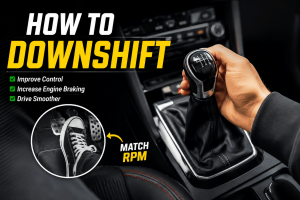
Downshifting means moving from a higher gear to a lower gear.
You may downshift when the vehicle slows, when you need additional acceleration, or when approaching a situation that requires more control.
For example, if you are cruising in a higher gear and slow significantly for a turn, staying in that gear may leave the engine at an unsuitable RPM. Selecting a lower gear can give you better response when you accelerate again.
The basic process is:
- Reduce speed as needed.
- Release the accelerator.
- Press the clutch.
- Select the lower gear.
- Release the clutch smoothly.
- Apply the accelerator as needed.
Avoid forcing the vehicle into an extremely low gear at high speed. A large RPM increase can make the car jerk and can place unnecessary stress on the drivetrain.
When approaching a corner, concentrate on braking and selecting an appropriate gear before the turn. Your attention should remain on traffic, pedestrians, road conditions, and the direction of travel.
How to Stop a Manual Car
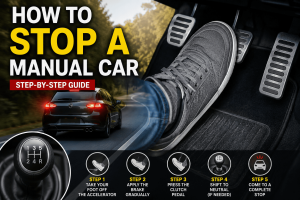
For a normal stop, release the accelerator and begin braking with your right foot.
As the vehicle slows toward a complete stop, press the clutch fully before the engine reaches a point where it may stall.
Once stopped, you can select neutral and release the clutch if you expect to remain stationary for a while. Alternatively, you can keep the clutch depressed if the stop is brief.
For example, at a long red light, selecting neutral can allow you to relax your left leg instead of holding the clutch down continuously.
For an emergency stop, braking and vehicle control take priority. Do not focus on making a perfect downshift while trying to avoid a collision. Brake firmly and maintain control of the vehicle.
Once stopped, press the clutch to prevent the engine from stalling.
How to Drive a Manual Car on a Hill
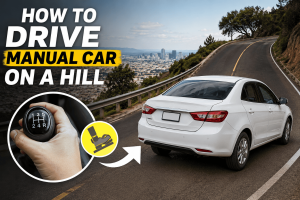
Hill starts are one of the most intimidating skills for beginners because the vehicle can roll backward.
One useful technique is to use the parking brake.
With the vehicle stopped on a hill:
- Keep the parking brake engaged.
- Press the clutch.
- Select first gear.
- Slowly release the clutch until you find the bite point.
- Apply gentle accelerator input.
- When the car is ready to move forward, release the parking brake.
- Continue releasing the clutch smoothly.
The exact amount of throttle and clutch movement depends on the vehicle and the steepness of the hill.
Do not practice hill starts in heavy traffic when you are still learning. Start on a mild incline in a safe environment.
As your clutch control improves, you will become more comfortable coordinating the pedals without relying heavily on the parking brake.
Common Beginner Mistakes
Releasing the Clutch Too Quickly
This is one of the easiest ways to stall the engine. The clutch needs controlled movement when starting from a stop.
Using Too Much Accelerator
More gas does not automatically make starting easier. Excessive throttle can make the vehicle surge forward and can increase clutch wear.
Riding the Clutch
Riding the clutch means keeping your foot partially on the pedal while driving. This can keep the clutch partially engaged and create unnecessary wear.
Once the shift is complete, remove your foot from the clutch pedal.
Looking Down at the Shifter
Beginners may be tempted to stare at the gear lever while shifting. Learn the shift pattern while parked so you can select gears with less visual attention.
Your eyes should remain focused on the road.
Practicing in Heavy Traffic
Traffic adds pressure and leaves less room for mistakes. Start in a quiet, safe location and gradually move into more demanding situations.
Forgetting the Parking Brake
Always check the parking brake before starting and when parking. A manual vehicle can move unexpectedly if it is left in an inappropriate state.
How to Practice Driving a Manual Car
Good practice is more valuable than simply driving around for hours.
Start with clutch control while stationary. Learn where the bite point is. Then practice moving forward a short distance and stopping.
After that, practice:
- Starting in first gear.
- Stopping smoothly.
- Moving from first to second.
- Moving from second to third.
- Downshifting.
- Turning at low speeds.
- Starting on gentle inclines.
- Reversing.
- Parking.
A quiet parking lot can be useful because it gives you space to concentrate on pedal coordination. Beginner driving resources also recommend low-traffic areas for early practice.
Do not rush into busy city traffic just because you can technically move the car. You should first be able to start, stop, shift, and respond to common situations without becoming overwhelmed.
Practice should gradually become more realistic.
How Long Does It Take to Learn a Manual Car?
There is no fixed number of hours required to learn manual driving.
Some people understand the basic clutch and gear movements quickly. Others need several practice sessions before their starts become smooth.
The first major milestone is being able to move away from a stop without regularly stalling. The next is shifting between gears without jerking. After that, you can work on hills, traffic, parking, and smoother downshifts.
Do not judge your progress by how quickly another person learned.
A better measurement is control.
If you can consistently start, stop, shift, and respond to traffic without panic, you are making real progress.
Remember that smooth manual driving comes from repetition. Your feet gradually learn how much clutch and throttle movement the vehicle needs.
Tips for Smoother Manual Driving
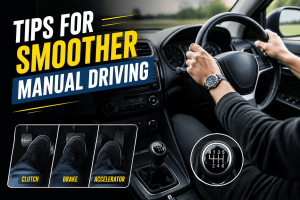
Keep these habits in mind as you improve:
- Learn the bite point before worrying about speed.
- Use gentle pedal movements.
- Do not rest your foot on the clutch.
- Learn the vehicle’s shift pattern before driving.
- Use the tachometer as a guide, not your only source of information.
- Listen to the engine.
- Select the appropriate gear for the road situation.
- Avoid unnecessary gear changes.
- Brake before turns when appropriate.
- Practice starts on flat ground before hills.
- Keep your attention on traffic rather than the gear lever.
- Follow the vehicle manufacturer’s recommendations.
- Give yourself enough space when learning.
One particularly useful habit is learning to recognize what the car is telling you. Engine sound, vibration, acceleration, and pedal feel all provide information.
With experience, you will need to think less about each individual movement.
FAQs
Is driving a manual car hard for beginners?
It can feel difficult at first because you are coordinating your left foot, right foot, and hand at the same time. The clutch is usually the biggest challenge. Once you learn the bite point and practice starting smoothly, the process becomes much easier.
What is the hardest part of driving a manual car?
For most beginners, moving away from a complete stop is the hardest part. You have to release the clutch gradually while adding enough accelerator to keep the engine running. Learning clutch control is the foundation for the rest of manual driving.
Why does my manual car keep stalling?
A manual car can stall when the clutch is released too quickly, when the selected gear is inappropriate for the vehicle’s speed, or when there is not enough engine power during a start. Slow down your clutch movement and practice finding the bite point.
When should I shift gears?
There is no single shift speed that works for every manual car. Engine size, gearing, road conditions, and driving style all matter. Use the owner’s manual as a reference and learn to recognize the engine’s sound and behavior.
Should I press the clutch when braking?
If you are coming to a complete stop, you generally need to press the clutch before the engine reaches a point where it would stall. For normal slowing without stopping, you do not necessarily need to press the clutch immediately.
Can I learn to drive a manual car by myself?
It is better to learn with an experienced driver or qualified instructor, especially when you are completely new to manual driving. Early practice should take place in a safe, low-traffic area where you can concentrate on vehicle control.
How do I stop stalling a manual car?
Focus on the clutch bite point. Release the clutch gradually instead of suddenly. Add gentle accelerator input as the vehicle begins to move. With repeated practice, your foot will become more familiar with the amount of clutch movement required.
Is it bad to keep my foot on the clutch?
Yes. Resting your foot on the clutch pedal can cause unnecessary clutch engagement and wear. Once you have completed a gear change, move your left foot away from the pedal and use the clutch only when needed.
How do I start a manual car on a hill?
Use the parking brake while finding the clutch bite point. Once the clutch and accelerator are positioned to move the vehicle forward, release the parking brake smoothly. Practice this on mild slopes before attempting steeper hills or busy traffic.
What gear should I use when turning?
The correct gear depends on your speed, the vehicle, and the turn. A common approach is to slow to an appropriate speed and select the suitable lower gear before the corner. Avoid entering a turn too quickly or making unnecessary gear changes while steering.



One comment on “How to Drive a Manual Car: A Beginner’s Step-by-Step Guide”