








What Does BMW Mean?
BMW is short for Bayerische Motoren Werke, which translates to Bavarian Motor Works in English. The name points directly to the company’s roots: “Bayerische” refers to Bavaria, the region in Germany where the company is based. The full legal name is BMW AG, and “AG” stands for Aktiengesellschaft, a German term for a corporation owned by shareholders.
Where the Name Came From
BMW didn’t start out as a car company. The story begins in Munich in 1913, when Karl Rapp founded Rapp Motorenwerke, a business focused on building internal-combustion engines for aircraft.
Rapp’s company went on to supply engines to the German air force during World War One, at a time when cars were still a novelty and long-distance travel relied mostly on trains. A related Munich firm, Gustav Otto’s aircraft-frame workshop, built the planes those engines powered — but Otto’s company went bankrupt in 1916 and was reorganized as Bayerische Flugzeugwerke (BFW).
The Bayerische Motoren Werke name, along with the blue-and-white roundel logo BMW still uses today, dates back to 1917 — the same year Karl Rapp left the company. In short, “BMW” isn’t a clever marketing invention; it’s a literal description of a Bavarian company that built motors, first for planes and only later for cars.
Does the BMW Logo Show an Airplane Propeller?
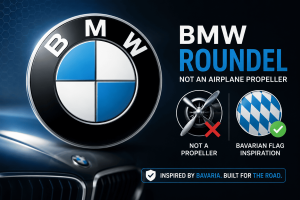
Almost everyone has heard this claim, and it’s a myth — though an understandable one given BMW’s aviation background.
The propeller association traces back to a 1929 advertisement, published while BMW was still building aircraft engines, that showed a plane with the BMW badge superimposed over its spinning propeller. A similar image ran again in a 1942 company publication, and the idea stuck in popular memory from there.
The real design story is simpler. The blue-and-white quarters of the logo are a direct nod to Bavaria’s state flag, honoring the company’s roots in Munich. Because using state symbols on a commercial logo was against local trademark rules at the time, BMW simply reversed the color order to stay compliant — which is why the badge shows the Bavarian pattern in inverted order when read clockwise from the top. The black outer ring is standard industrial-logo styling of the era rather than a reference to anything aeronautical.
So the short version: it’s the Bavarian flag, rearranged to sidestep a trademark law — not a propeller.
A Quick Timeline of the BMW Name and Badge
| Year | Milestone |
|---|---|
| 1913 | Karl Rapp founds Rapp Motorenwerke in Munich, building aircraft engines |
| 1916 | Gustav Otto’s aircraft-frame company goes bankrupt and is reorganized as Bayerische Flugzeugwerke (BFW) |
| 1917 | The company is renamed Bayerische Motoren Werke (BMW); the blue-and-white roundel logo is introduced |
| 1929 | An aircraft advertisement pairs the BMW logo with a spinning propeller, sparking the “propeller myth” |
| 1974 | BMW launches its long-running “The Ultimate Driving Machine” slogan |
| 2020 | The roundel is redesigned with a flat, transparent outer ring |
“Beemer” vs. “Bimmer” — What’s the Difference?
Once people know what BMW stands for, the slang usually comes up next. “Beemer” and “Bimmer” are both informal English terms for a BMW vehicle, loosely based on how the three letters sound together. Convention in the US often splits the two, with some drivers reserving “Beemer” for motorcycles and “Bimmer” for cars — though usage varies quite a bit. In Canada, “Bimmer” tends to cover both cars and motorcycles. There’s no official BMW ruling here; it’s regional habit more than anything the company has defined.
What Does the BMW Slogan Mean?
BMW’s best-known slogan, “The Ultimate Driving Machine,” debuted in 1974 and stuck around for decades. It was briefly swapped for the single word “Joy” in 2010, but the original line returned in 2012 and remains the brand’s signature tagline today.
FAQ
What does BMW stand for in English? BMW stands for Bayerische Motoren Werke, which translates to Bavarian Motor Works.
Is BMW a German word? Yes. “Bayerische” is German for “Bavarian,” and “Motoren Werke” means “motor works” — though the phrasing is a little unusual in German, since “Motorenwerke” is normally written as one word rather than two.
Does the BMW logo represent an airplane propeller? No. The blue-and-white pattern comes from the Bavarian flag, with the color order reversed to comply with old trademark rules. The propeller idea comes from a 1929 advertising campaign, not the logo’s original design intent.
What does “AG” mean after BMW? “AG” stands for Aktiengesellschaft, a German term for a corporation owned by shareholders.
Why is “Beemer” sometimes used for motorcycles and “Bimmer” for cars? There’s no official BMW distinction — it’s an informal convention some English speakers follow, and usage isn’t consistent across regions.
When did BMW start making cars instead of just engines? BMW began as an aircraft-engine manufacturer in the 1910s and only expanded into motorcycles, and later automobiles, as the company’s focus broadened beyond aviation in the decades that followed.


One comment on “What Does BMW Mean? The Story Behind the Name”