





Choosing the right truck wheels is about more than finding a design you like. Complete Truck Wheel Buying Guide in 2026 gives U.S. truck owners a clear look at the wheel specifications that matter for fitment, safety, performance, and everyday driving. The wrong wheel size, bolt pattern, or offset can cause clearance issues. A wheel with a low load rating can also create serious problems for trucks used for towing or heavy work.
Before buying aftermarket wheels, check your truck’s exact year, make, model, and trim. You should also look at the wheel diameter and width, bolt pattern, offset, center bore, load rating, and construction material. Your driving needs matter as well. A daily driver, tow rig, work truck, and off-road pickup may all need different wheel setups. This guide helps American truck owners compare their options, avoid expensive fitment mistakes, and choose wheels that suit the way they actually use their trucks.
What to Know Before Buying Truck Wheels in 2026
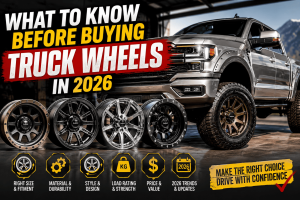
Before buying truck wheels in 2026, take a few minutes to check the basics. Start with your truck’s exact year, make, model, and trim. Wheel size, bolt pattern, offset, and hub fit can vary between different configurations. Next, check the factory wheel and tire specifications in your owner’s manual or the Tire and Loading Information Label. NHTSA recommends using the vehicle’s specified tire size and load information when selecting replacement tires.
Your truck’s purpose should also guide your choice. A daily driver may work well with lightweight street wheels. On the other hand, a truck used for towing, hauling, off-roading, or regular work needs wheels and tires with suitable load ratings. Finally, think about the complete cost. Your budget should include wheels, tires, mounting, balancing, installation, and related parts. Choosing wheels only because they look good can lead to fitment or load-capacity problems. A properly matched setup can give you better safety, handling, and confidence on the road.
| TruckTruck TypeWheel Buying FocusBest Use | Size | …. | works |
|---|---|---|---|
| Ford F-Series | Full-size / Heavy-duty | Size, bolt pattern, offset, load rating | Towing & work |
| Chevrolet Silverado | Full-size / Heavy-duty | OEM fitment, wheel diameter, load rating | Daily driving & towing |
| Ram Pickup | Full-size / Heavy-duty | Offset, backspacing, tire clearance | Towing & performance |
| GMC Sierra | Full-size / Heavy-duty | Bolt pattern, wheel width, load capacity | Work & towing |
| Toyota Tacoma | Midsize | Wheel size, offset, tire clearance | Off-road & daily driving |
| Ford Maverick | Compact | Correct wheel size, offset, tire compatibility | Daily driving |
| Toyota Tundra | Full-size | Load rating, bolt pattern, wheel diameter | Towing & work |
| Chevrolet Colorado | Midsize | Offset, wheel width, tire size | Off-road & daily use |
| Nissan Frontier | Midsize | Bolt pattern, offset, load rating | Work & off-road |
| Ford Ranger | Midsize | Wheel diameter, offset, tire clearance |
Daily use & off-road
How to Find the Right Truck Wheel Size
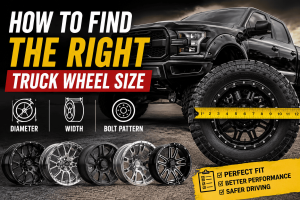
Choosing the right truck wheel size starts with your truck’s factory specifications and the type of driving you do. Common options include 17-inch, 18-inch, and 20-inch wheels, although some trucks can use larger sizes. A larger wheel can give your truck a more aggressive look and may change steering response. However, it normally means using a tire with a shorter sidewall, which can make the ride feel firmer.
Understanding Wheel Diameter
For daily driving and off-road use, 17- or 18-inch wheels often leave you with more tire sidewall. That extra sidewall can provide a more comfortable ride and better protection from rough surfaces. Meanwhile, a 20-inch or larger wheel can give your truck the upgraded appearance many owners want.
Understanding Wheel Width
Wheel width needs to work with the tire you plan to use. Wider wheels can offer certain handling benefits, but they can also create clearance issues. This is especially important when you are running larger tires or have suspension modifications.
How Wheel Size Affects Truck Performance
Wheel size can influence ride quality, handling, braking, fuel economy, and off-road capability. For that reason, check the wheel diameter, width, offset, bolt pattern, tire size, and brake clearance before you buy. The goal is to choose a setup that works well for your truck instead of choosing a wheel based only on appearance.
Truck Wheel Bolt Pattern Explained
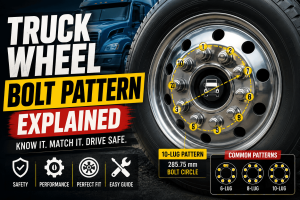
A truck wheel bolt pattern, also known as the lug pattern or PCD, tells you how many lug holes a wheel has and the diameter of the circle they create. For example, 6×135 means the wheel has six lug holes arranged on a 135 mm bolt circle. Both measurements need to match your truck’s hub for the wheel to fit correctly.
To identify your truck’s bolt pattern, count the lug holes and measure the bolt circle. For 4-, 6-, and 8-lug wheels, measure from the center of one lug hole to the center of the opposite hole. Five-lug wheels use a different measurement method.
Common U.S. truck patterns include 6×135, 6×139.7 (6×5.5″), 8×165.1 (8×6.5″), and 8×170.
Do not assume that two patterns are interchangeable just because they look similar. For example, 6×135 and 6×139.7 are different. Using the wrong pattern can result in poor seating, vibration, stud damage, or unsafe fitment. Always confirm the exact year, make, model, and trim before ordering wheels.
Wheel Offset and Backspacing: What Truck Owners Need to Know
What Is Wheel Offset?
Wheel offset describes the distance between the wheel’s centerline and its mounting surface. In simple terms, it helps determine where the wheel sits in relation to your truck’s fender.
Positive vs. Zero vs. Negative Offset
- Positive offset: The wheel sits farther inside the truck.
- Zero offset: The mounting surface sits in line with the wheel’s center.
- Negative offset: The wheel sits farther outward.
What Is Wheel Backspacing?
Backspacing is the distance from the wheel’s mounting surface to its inner edge. It is useful when checking how much space the wheel has around suspension components and brakes.
How Offset Changes Tire and Suspension Clearance
The wrong offset can push the wheel too far inward or outward. As a result, the tire may rub against the fender, suspension, or steering components. Correct offset helps maintain the clearance your truck needs.
How to Choose Offset for Stock and Lifted Trucks
For a stock truck, staying close to the factory wheel specifications is usually the simplest approach. A lifted truck may allow a more aggressive offset, but the lift alone does not determine fitment. Tire size, suspension parts, and available clearance all need to be considered. Always check the complete setup before buying.
Wheel Load Rating: One of the Most Important Factors
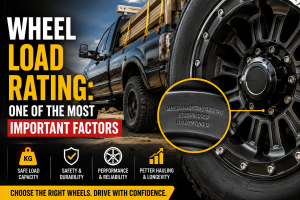
Wheel load rating tells you how much weight a wheel is designed to support. When choosing truck wheels in the USA, compare the wheel’s load capacity with your truck’s GAWR, GVWR, axle rating, and tire requirements. NHTSA guidance states that, for applicable non-passenger vehicles, the combined maximum tire load ratings on an axle must meet or exceed its GAWR.
This becomes especially important if you use your truck for towing, hauling, work, or off-road driving. A wheel can look perfect and still be the wrong choice if its load rating is too low. Always check the manufacturer’s specifications before making a purchase.
Aluminum vs. Steel Truck Wheels
Choosing between aluminum and steel wheels depends on how you use your truck, how much you want to spend, and the conditions where you drive in the USA.
Aluminum Wheels
Aluminum wheels are generally lighter than steel wheels. Because of that, they can reduce unsprung weight and may help with handling, ride quality, and fuel efficiency. They also come in a wide range of designs and finishes, which makes them popular with daily drivers.
Aluminum naturally resists rust, so it can be a practical option in areas where road salt is common. However, higher-end aluminum wheels can cost more, and some designs may be more vulnerable to severe impacts.
Steel Wheels
Steel wheels are known for their strength, durability, and lower cost. For that reason, they are common on work trucks, fleet vehicles, and some off-road builds. They can handle demanding use, but their extra weight may affect ride quality and efficiency. Their simpler appearance may also be less appealing to some truck owners.
Which Is Better for Your Truck?
Choose aluminum if lower weight, appearance, and everyday driving are your priorities. Choose steel if durability, heavy-duty use, and affordability matter more.
Cast, Flow-Formed, and Forged Wheels Compared
Cast Wheels
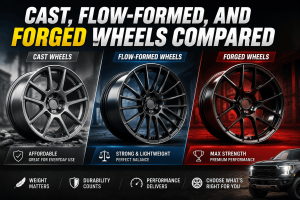
Cast wheels are usually the most affordable option and are widely used for everyday driving. The manufacturing process involves pouring molten aluminum into a mold. This makes cast wheels easy to produce in many sizes and designs.
Flow-Formed Wheels
Flow-formed wheels sit between traditional cast wheels and forged wheels. The wheel starts as a casting and is then strengthened through heat and pressure while it spins. This process can produce a lighter and stronger wheel than a standard cast design.
Forged Wheels
Forged wheels are produced from solid aluminum that is shaped under extreme pressure. They offer an excellent strength-to-weight ratio. However, that performance usually comes with a much higher price.
Which Wheel Construction Is Best for Your Budget?
Choose cast wheels when keeping costs down is the main goal. Flow-formed wheels are a good middle option for buyers who want a balance of weight, strength, and price. Forged wheels make more sense when maximum strength and weight savings justify the extra cost.
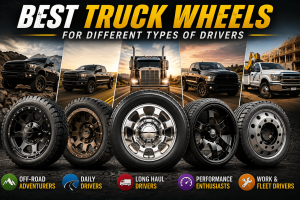
Best Truck Wheels for Different Types of Drivers
Best Wheels for Daily-Driven Trucks
Cast or flow-formed wheels can be practical choices for commuting, highway driving, and regular daily use.
Best Wheels for Towing and Hauling
For towing and hauling, focus on the correct load rating and strong construction rather than appearance alone.
Best Wheels for Off-Road Trucks
Choose durable wheels designed to handle impacts, rocks, rough trails, and the conditions you expect to encounter.
Best Wheels for Work Trucks
Work trucks benefit from wheels that offer strong load capacity, durability, and easy maintenance.
Best Wheels for Lifted Trucks
For lifted trucks, match the wheel diameter, width, offset, backspacing, and tire clearance to the suspension setup.
Best Wheels for Stock Trucks
For a stock truck, wheels that closely match the factory specifications can provide predictable fitment and reliable everyday performance.
How to Choose Truck Wheels for Towing
Choosing truck wheels for towing starts with safety and proper fitment. First, check the wheel and tire load ratings to make sure they can handle your trailer and cargo. Then compare those ratings with your truck’s axle ratings and payload capacity.
Oversized wheels are not automatically better for towing. They can reduce tire sidewall height and may affect ride quality and handling. A taller tire sidewall can provide a smoother ride and better impact absorption during towing. Before buying, check the complete wheel-and-tire combination, including size, offset, bolt pattern, load rating, and tire rating. Most importantly, follow your truck manufacturer’s towing specifications.
How to Choose Wheels for Off-Roading
Choosing off-road wheels is about strength, fitment, and the terrain you plan to drive on. Start with wheels that are rated for your truck’s weight and the demands of rocks, mud, sand, and rough trails.
A smaller wheel diameter can give you more tire sidewall. This can help absorb impacts and improve traction when the tires are aired down. Also, check brake clearance, wheel width, offset, backspacing, and suspension clearance before buying.
Your tire sidewall should also suit the wheel and terrain. For extreme low-pressure driving, beadlock or beadlock-compatible options may be appropriate where suitable. Above all, choose durability and correct fitment over aggressive styling.
Truck Wheel Fitment: What You Must Check Before Buying
Before buying truck wheels in the U.S., check more than just the wheel size. Start with your truck’s exact year, make, model, and trim. Then confirm the wheel diameter, width, bolt pattern, offset, backspacing, and center bore.
The bolt pattern needs to match the hub correctly. You should also check the wheel’s load rating, especially if you tow or haul. Brake-caliper, suspension, and fender clearance are equally important.
Finally, make sure the new wheel works with the correct tire size. Check that the lug nuts and mounting hardware have the proper seat type. If you are unsure about any measurement, having a professional test-fit the wheels can help prevent rubbing, vibration, and clearance problems.
How to Check Truck Wheel Fitment Yourself
Checking wheel fitment yourself can save you from buying wheels that do not work with your truck. Start with the driver-door tire information label and check the recommended tire size and load information. Next, look through the owner’s manual for the factory wheel and tire specifications.
Measure your existing wheel’s diameter and width, then confirm the bolt pattern. After that, check the wheel’s offset and backspacing. These measurements can make a major difference in suspension and fender clearance.
Finally, make sure there is enough room around the brakes and suspension. NHTSA recommends using the vehicle’s tire information label or owner’s manual to determine appropriate tire specifications.
How Much Do Truck Wheels Cost in 2026?
In the U.S., truck wheels in 2026 typically cost about $100–$1,500+ per wheel, depending on size, construction, brand, and finish. Budget cast wheels can start below $200 each, while mid-range options often fall around $200–$500. Premium and forged wheels can reach $600–$1,500+ per wheel.
Remember that the wheel price is only part of the total cost. You may also need to pay for mounting and balancing, which can add roughly $80–$150, along with lug nuts, TPMS sensors, and tires. Therefore, do not choose a wheel based only on its price. Proper fitment, load rating, durability, and warranty can offer better long-term value.
Common Truck Wheel Buying Mistakes to Avoid
Buying truck wheels is about more than choosing a style you like. A poor fit can create clearance, handling, or load-capacity problems. For that reason, avoid these common mistakes when shopping for wheels in the USA.
Buying Wheels Based Only on Appearance
Aggressive styling can make a truck look great, but fitment and strength should come first. Always check your truck’s exact specifications before buying.
Ignoring the Load Rating
Choose wheels with a load capacity that meets or exceeds your truck’s requirements. This is especially important for towing and hauling.
Choosing the Wrong Bolt Pattern
Confirm the exact bolt pattern, center bore, and lug hardware before buying. A pattern that looks similar is not necessarily compatible.
Ignoring Offset
Incorrect offset can cause tire rubbing or suspension interference. Always check both offset and backspacing before purchasing.
Buying Wheels That Do Not Clear the Brakes
Make sure the wheel design leaves enough room for your factory or upgraded brake calipers.
Choosing Oversized Wheels Without Considering Tire Size
Larger wheels require compatible tires. You also need enough fender and suspension clearance for the complete combination.
Forgetting About Tire and Wheel Weight
A heavier wheel-and-tire package can affect ride quality, acceleration, braking, and fuel economy.
Assuming Every Wheel Fits a Lifted Truck
A lift kit does not automatically make every wheel and tire combination fit. Check the suspension, fender, and steering clearance before installation.
How Truck Wheels Affect Tires, Handling, and Fuel Economy
Truck wheels can affect much more than the way your pickup looks. Their weight, size, and fitment can influence tire performance, handling, ride comfort, and fuel economy.
For example, heavier wheels increase unsprung weight. This can make a truck feel less responsive, especially on rough U.S. roads. Larger wheels usually require shorter tire sidewalls. That can improve steering response and stability, but it may reduce cushioning and ride comfort.
Wheel and tire combinations can also affect rolling resistance. Low-rolling-resistance setups may help improve fuel efficiency. Proper alignment matters too because poor alignment or incorrect fitment can contribute to uneven tire wear. Before upgrading, check the wheel size, offset, tire load rating, and overall diameter for your truck.
How to Maintain Truck Wheels
Good wheel maintenance can help protect your truck’s safety, handling, and tire life. Start by cleaning the wheels regularly to remove dirt, brake dust, and road salt. Then look for cracks, bends, or other visible damage, especially after hitting potholes.
Also, inspect the lug nuts and make sure they are properly tightened. Check tire pressure regularly and follow the pressure listed by the vehicle manufacturer. Watch for rust or corrosion that could affect wheel components.
After installing new wheels, recheck the wheel hardware after driving a short distance. NHTSA recommends regular tire maintenance, including proper inflation, inspection, rotation where applicable, balancing, and alignment.
Car Repair Hacks in 2026 That Truck Owners Should Know
Truck owners can avoid many roadside problems with a few simple maintenance habits. For example, keep a basic repair and inspection kit, portable tire inflator, and accurate pressure gauge in your truck.
Before long trips, check your tire pressure and inspect the wheels, tires, and lug nuts for visible problems. It is also useful to learn how to recognize slow tire leaks, wheel imbalance, and uneven tire wear before they turn into expensive repairs.
Some minor problems can be handled as DIY jobs. However, damaged wheels, tires, suspension components, or brakes should be checked by a professional. Most importantly, do not depend on temporary fixes for structural wheel damage. These simple car repair habits can help improve safety and keep your truck ready for U.S. roads.
Truck Wheel Buying Checklist for 2026
Before buying truck wheels in 2026, confirm every important fitment detail for your specific vehicle. Start with the exact year, make, model, and trim, then verify the factory wheel diameter and width. Next, check the bolt pattern, offset, backspacing, and center bore.
Wheel specifications can vary between truck configurations, so appearance alone should never be your deciding factor.
- Confirm the truck’s year, make, model, and trim.
- Confirm wheel diameter and width.
- Verify bolt pattern, offset, backspacing, and center bore.
- Check the wheel’s load rating.
- Confirm brake, suspension, and fender clearance.
- Match wheels with the correct tire size.
- Verify lug nuts and mounting hardware.
- Check TPMS compatibility.
- Compare the complete installed cost.
- Have a professional verify fitment if uncertain.
Proper TPMS compatibility is also important because aftermarket wheels may require compatible sensors or hardware.
Frequently Asked Questions
How do I know what wheels fit my truck?
Start with your truck’s year, make, model, and trim. Then match the bolt pattern, wheel diameter, width, offset, backspacing, center bore, and load rating. Finally, confirm the fitment with your truck manufacturer or a trusted wheel fitment guide.
What is the most important truck wheel specification?
There is no single specification that determines fitment. Instead, you need to consider the bolt pattern, size, offset, center bore, clearance, and load rating together.
Is a bigger wheel better for a truck?
Not necessarily. Bigger wheels can improve appearance and may change handling. However, they often require lower-profile tires, which can reduce ride comfort. Choose the wheel size based on how you use your truck, whether that means towing, off-roading, or daily driving.
Are steel or aluminum wheels better for trucks?
Steel wheels are usually heavier, durable, and budget-friendly. Aluminum wheels are lighter and offer more styles. For work trucks, steel can be a practical choice. For everyday driving, many owners prefer aluminum.
What wheel size is best for towing?
For towing, load rating and proper tire selection matter more than wheel diameter. Choose wheels and tires that meet your truck manufacturer’s specifications and can safely support the load.
Can I put bigger wheels on a stock truck?
Sometimes, yes. However, you need to check tire clearance, wheel offset, backspacing, brake clearance, suspension geometry, and manufacturer specifications. Bigger wheels may also require different tires or other modifications.
Do aftermarket wheels affect truck safety?
Yes. Incorrectly sized or low-rated wheels can create clearance, handling, or load-capacity problems. Always choose wheels designed for your specific truck and intended use.
How often should truck wheels be inspected?
Inspect your wheels during routine maintenance and whenever you notice vibration, damage, or unusual handling. You should also check them after hitting a pothole, installing new wheels, or driving off-road.
Final Thoughts
Choosing the right truck wheels in 2026 is about more than appearance. U.S. truck owners should confirm the exact fitment, wheel size, offset, bolt pattern, load capacity, and tire compatibility before buying. Your truck’s intended use matters too. A wheel that works well for daily driving may not be the best choice for towing, hauling, off-roading, or heavy-duty work.
Always compare wheel specifications with your truck manufacturer’s requirements and verify the correct tire size. Most importantly, put safety, durability, and proper fit ahead of appearance. Ultimately, the best choice is simple: buy a wheel that fits your truck correctly, supports the work you expect it to handle, and works properly with the right tire.


One comment on “Complete Truck Wheel Buying Guide in 2026: Best Wheels”